About​ ​Safety & Security 2024 Grants

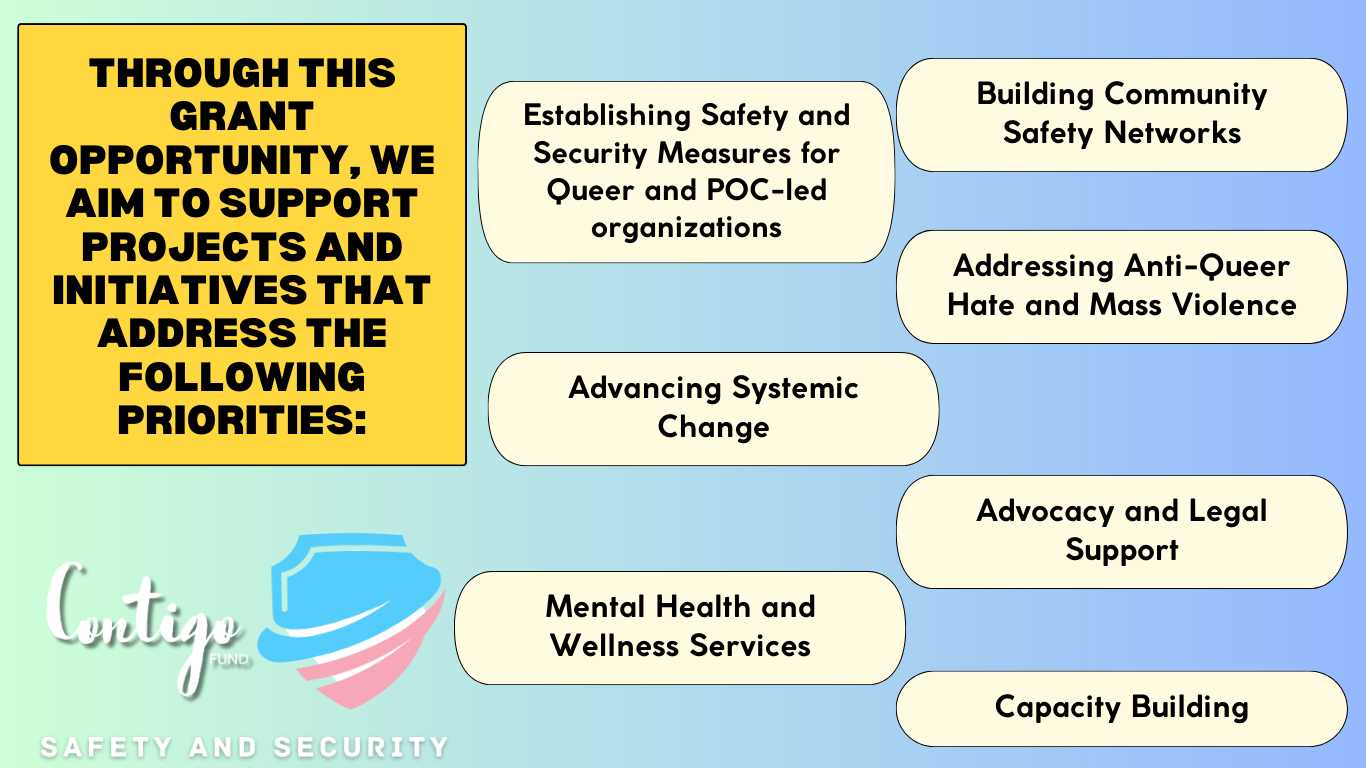
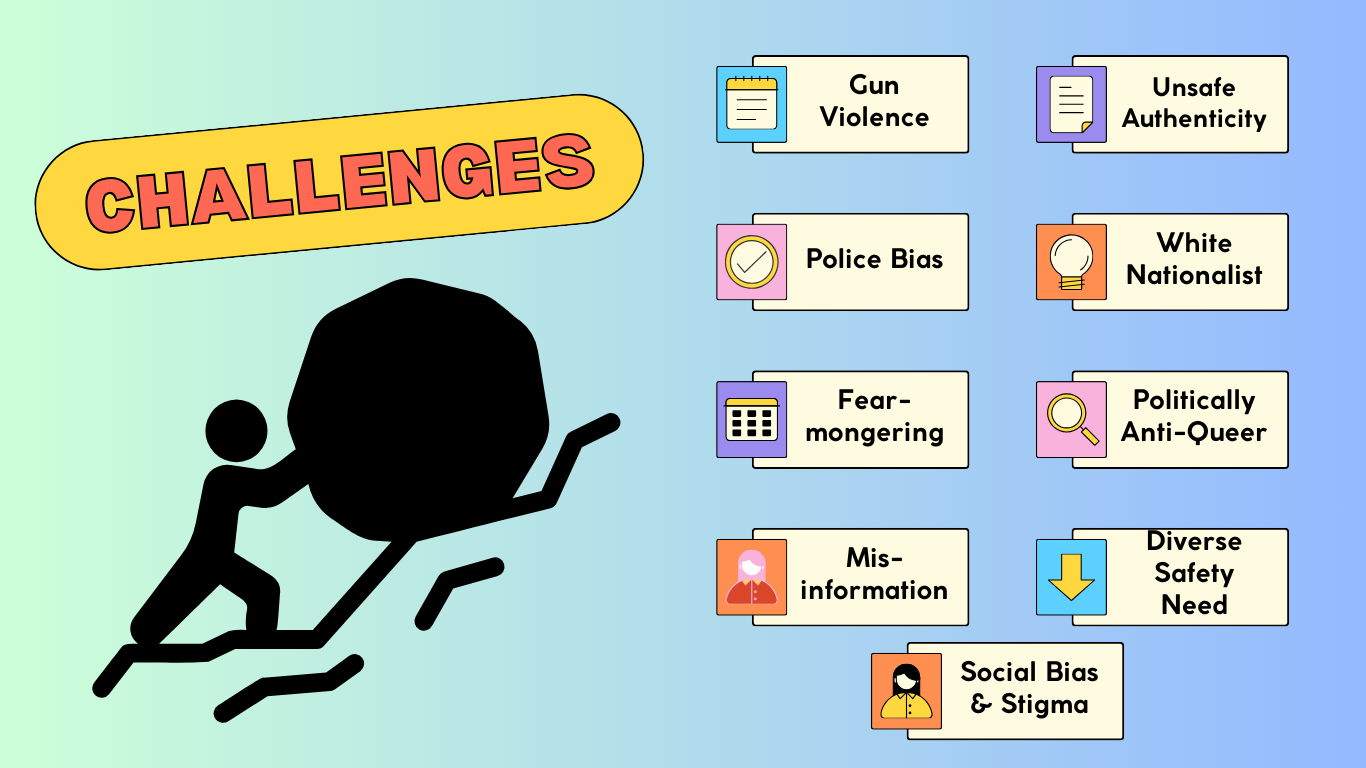
Across Florida and the US South, Queer and Trans communities, especially Trans youth and women of color and those on the frontlines across our movements for social justice are experiencing sharp levels of bigotry and violence. In response, Contigo is launching a unique and urgent grant cycle focused on (a) supporting organizations to establish safety and security measures in response to the rise of anti-Queer hate and mass violence and (b) advocacy and organizing advancing systemic change – including addressing gun violence and advancing gun control measures.  These efforts must center transgender, nonbinary, drag communities, youth, immigrants, and people of color. 

What We Mean When We Talk About Safety and Security

For movement groups, “Safety” means being protected from danger, risk, or injury, and creating the conditions where those harms can’t happen. “Security” refers to the process of ensuring safety. These concepts encompass a broad range of conditions, practices, and feelings that allow for thriving, self-determined, and liberated communities and impactful social justice movements.  The challenges faced by Queer and POC-led groups have reached a critical juncture, with sustained attacks from well-resourced, powerful opposition forces putting lives and organizations at risk, compromising their ability to secure victories, and jeopardizing the communities they serve. Safety is a critical issue for marginalized communities, and specifically for Queer and Trans individuals who often face multiple forms of oppression. Social justice movements have always been met with vigorous and often violent opposition throughout US history. In recent years, as these movements have gained increasing visibility and power, the threats they face have gained reinvigorated steam.  Building safety and security is an ongoing, holistic process and requires durable infrastructure. The process should be informed and driven by those impacted, foster community, and take care not to inadvertently create psychological insecurity. For instance, over surveillance or highly visible police presence in certain circumstances may provide security for an open public event but may not allow every person at that event to feel individually safe. 
Grants and Decision Process

Contigo 2023 Safety and Security Grant Cycle:

  • Grants can be made up to a maximum of $5,000 and limited to one application per organization (joint applications will be considered on a case-by-case basis), and
  • Applicants can apply for a 6-month grant up to the maximum and must demonstrate how a proposal would be accomplished in that period for the amount requested.

Grant Cycle Application, Distribution, and Reporting Timeline

  • December 18, Monday: Public release of RFP application
  • January 15, Monday: Online portal opens
  • January 31, Wednesday: Final deadline – applications due by 5 pm EST
  • Mid-to-Late February: Final decisions on grants & notification 
  • Mid-March: Grants distributed
  • October 1st, Tuesday: Final Reports from grantees due by 5 pm EST

Note: proposals must be filled out and submitted in the online portal

Submitting a Successful Application: Eligibility, Process and Timeline

Who Is Eligible to Apply

Contigo Fund seeks proposals for efforts based in Central Florida supporting Queer communities historically marginalized by society from equal opportunity and power and advancing racial, economic, and gender justice:

  • Organization must be based in Central Florida (Orange, Osceola, Seminole, Lake, Polk, and Volusia Counties), and proposed efforts must uniquely serve Central Florida’s Queer communities.
  • Groups or proposed projects/programs must be directed/led by Queer leader(s).
  • Efforts should help sustain and grow capacity and forward movement to empower Queer people living at the intersection of marginalized identities, particularly Black and Latinx individuals, immigrants, and other communities of color.
  • Must be a 501(c)3 nonprofit organization or fiscally sponsored by a 501(c)3 nonprofit organization.  To apply, groups do not need 501(c)(3) tax-exempt status.  Those lacking 501(c)(3) status can apply under the auspices of fiscal sponsorship of an established 501(c)(3).  Fiscally sponsored groups are required to submit a fiscal sponsorship agreement outlining the roles of both the fiscal sponsor and the fiscally sponsored group and signed by representatives of both parties.  If your group does not yet have a fiscal sponsor, contact Contigo Staff for assistance connecting with potential sponsors. 
  • Fiscally sponsored groups need to have an oversight and accountability structure in place or develop a plan for such a structure before receiving a grant.  The oversight and accountability structure for the group can be a Community Steering or Advisory Committee of local community members that reflects the community the group seeks to support, setting the vision of the project and guiding its work like a board of directors.  Please note the oversight and accountability structure is separate from the fiscal sponsor’s governance structure.  The community steering / advisory committee informs the group’s work in alignment with the group’s mission and oversight of the group’s financial health and executive leadership.  The oversight and accountability structure in place – or plan to develop one – must include an outline of the roles and responsibilities of the committee and any staff, including how the committee will oversee staff.
  • Extreme preference will be given to organizations with less than $1 million in expenses.
  • Regardless of their structure or age, the applicant’s proposal should demonstrate their alignment with Contigo’s values and potential for advancing its vision and theory of change.
  • Preference is given to projects and programs that respond to a distinct unmet need in the target communities and employ medium-term to long-term solutions.
  • Applicants must be a part of a learning community and will be asked to participate with other community leaders, including convenings, leadership, organizational development training, and peer learning opportunities. Contigo will cover training costs, and the applicant core staff and board or community steering committee or community advisory board members should be prepared to devote appropriate time and thought to participate actively in these opportunities.

Grants will not be awarded to

  • Efforts outside of Central Florida (Orange, Osceola, Seminole, Lake, Polk, and Volusia Counties)
  • For charity, direct cash assistance, or individual scholarships
  • Efforts led by other philanthropic grantmaking institutions or for the purpose of re-granting
  • Health service organizations (including those that operate pharmacies) with revenue generated from the 340B drug program that do not reinvest 100% of that revenue into community programs for and led by impacted communities

Who Makes Grant Decisions

Contigo Fund serves as a participatory and social justice model for grantmaking in which decision-making power about grants is in the hands of the communities most impacted by funding decisions. Our approach brings the principle of “nothing about us without us” to philanthropy and recognizes that those closest to the challenges we face are closest to the solutions we need. To accomplish this, and in alignment with our values, we identified and recruited a Community Board and form Community Steering Committees to guide the distribution of grants and determined that it must be made up of leaders from the local community and principally include leaders who are a part of and rooted in Queer communities historically marginalized by society from equal opportunity & power.  All Community Board and Community Advisory Committee members agree to a conflict of interest agreement, including conflicts arising from employment, financial benefit, personal relationships, professional relationships or other interests. If applicable, any one condition may serve to disqualify a reviewer from participating in the review of an application or proposal. A conflict of interest may be real or apparent.